Friday, May 8, 2015

Old Catherine Review


Note: This is an old review the the game Catherine that I wrote for a gaming site a couple years ago.  I'm putting it back up just to have, and also to start back into reviewing games when I can.  By now nothing here is relevant, but maybe some people still haven't heard of this game, or will just find it fun to read. 


Where do you start when explaining a game like Catherine?  The easy way out would be to simply call it a puzzle game, and while that wouldn’t be a lie, the game is much more than that.  Catherine is a game that wants to throw the player into a situation to make them chose how they would react if it was happening to them, and the elements of the game such as the questions you are asked between the puzzle portions, and how you interact with the other characters, determine how the story progresses.  It’s one of, if not the most, original game I have seen come out in recent memory in terms of both game play and story.  The game calls itself “an unconventional romantic horror”, which is probably the best way to describe the genre.  Because it is so unique, it might be a little hard to grasp what the game really is, so we’re going to take it one “block” at a time.  That’s a pun...you’ll get it later.  Strap in, this is going to be a long one.


Let’s begin with the main character, Vincent.  Vincent is a 32 year old office worker who is currently in a 5 year relationship with his girlfriend Katherine (and no, the K is not a typo).  She has begun pressuring him to take their relationship to the next level and get married, but Vincent isn’t too sure about that.  He likes the way his life is, and doesn’t want to change it.  This is just one of the things he discusses with his drinking buddies, who he goes out with every night.  I found Vincent to be a very sympathetic protagonist (ahh big words!).  He is a flawed and conflicted individual who really doesn’t have a clue half the time.  It’s hard to imagine players not feeling for the guy as his life only spirals more and more out of control.  If you compared him to other video game characters, then you might just think he’s sympathetic because he’s sort of an underdog, but if you take him just as a person, then that’s all you’ll find.  Vincent is just a man with flaws that are no different than ones you or I may have.  


The story begins, spoiling as little as possible, with Katherine giving hints to Vincent that they should get married and settle down.  Vincent is resistant, and later goes to the “Stray Sheep” bar with his friends.  After some talking and drinking, (alright, a lot of drinking) his friends go home and leave Vincent to continue drinking alone.  That is until an attractive young woman asks to join him.  This is all Vincent remembers, at first, before entering his nightmare.  When he wakes up the next morning, he finds this new girl named Catherine (What are the odds?) lying next to him in bed.  From there things only seem to get worse for Vincent, such as hearing rumours of how nightmares are killing men who are cheating, as he, or rather you the player, have to decide what he should do about cheating on Katherine.  This is a game that really emphasises its story, and tries to minimize areas where you are doing things unrelated to what is going on.  That being said, if you are not at all interested in the story or characters, there is still fun to be had, but you may feel short changed.  Also, since the game has 8 endings (did I forget to mention that?) there is plenty of incentive to replay it to see what other ways the story can unfold, but aside from upping the difficulty, the puzzles will stay the same. 


Now we reach the game play, which is split into two parts.  The first is when you play as Vincent while he is awake at the bar.  While here, you are encouraged to talk with not only your friends, but all the other patrons, about their problems.  Every once in a while, they will ask you a question where you can pick one of two options as a response, and depending on your response, a little meter will move toward the blue or red side.  Because of the way “karma” bars have been used in games before, you will probably think that the blue side is good, and red is evil or bad, but that isn’t exactly true in Catherine.  Most of the time the questions you are asked have no clear right or wrong answer, but are just meant to try and judge who you are as a person.  Personally, I think two neutral colors should have been used here, just so players wouldn’t be conditioned to think one side is the “bad” side.  In addition to these questions, you will learn about all these other character’s lives, and hear how they all seem to have started having nightmares...interesting.  While you are talking with people in the bar, time is passing, and different people will come and go throughout the night so it is beneficial to stay a while if you want to hear everyone’s story.  Also as time goes on, you will receive text messages, mainly from K/Catherine.  If you chose to respond to their messages, you get to chose between usually 2 or 3 options for each line of text.  Depending on what line you chose to begin the text with, the next lines options will be different, so cycle through them to be sure you are saying what you really want to say.  How you respond will continue to move your “karma” meter.  If talking to the other people in the bar isn’t interesting to you, you can always throw back your glass and hear Vincent do a little monologue about his situation.  After three sips, your glass will empty and you will be given a bit of trivia about whatever you were drinking (obviously).  These bits of info have no in game importance, aside from an achievement to hear them all, but could be cool if you’re into that sort of thing.  You will notice three little beer bottles on the bottom left of the screen filling up each time you finish a drink.  Once all three are full, you are completely drunk, but you could still drink more if you really wanted to...  After becoming fully drunk, Vincent starts walking around in a slow stumble that is pretty funny to see the first time, but there is an even better advantage than seeing him nearly trip over his own feet.  The drunker you become before entering a nightmare, the faster you will move once inside it (Makes sense...right?).  Once you have done as much or as little as you want in the bar, you can chose to leave and return home where the nightmares will begin.  
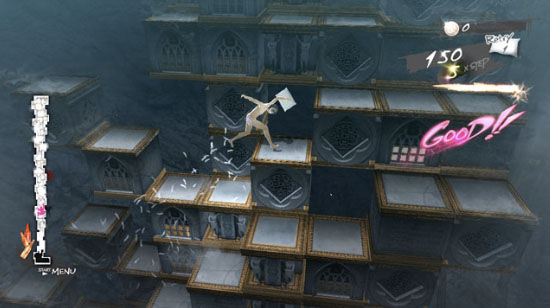


The nightmares are where the puzzling begins.  Each night Vincent will have to climb a tower of blocks to reach the top, but naturally it’s not as easy as just walking up.  The fact that he is in his underwear, clutching his pillow, and has sheep horns only adds to the nightmarish atmosphere he is in.  The blocks are not positioned to allow you to walk up with no problems, but require you to push and pull them into useable arrangements.  While you are doing this, the lower levels of blocks are falling away, so time is of the essence.  At times, this fear of falling may make you want to act swiftly, but it is all too easy to move the blocks in such a way that you trap yourself.  Also, each night a new block type is introduced that can radically change your current techniques.  It can be something as simple as an immoveable block, or one that shoots spikes up if you stand on it for more than a second.  If you want to survive, you will have to adapt your strategy almost every night.  You may not think it at first, but there are a lot of techniques to learn in order to progress through the game.  For example, gravity doesn’t work the same in the nightmares (as it often doesn’t) so blocks with nothing below them can hover in the air as long as they have another block connected at its edge.  This allows you to effectively push a block off the edge of the one below it to make a stepping block.  Since Vincent can only pull himself up one block at a time, you will be constantly pushing and pulling blocks in new ways to make a staircase to the top.  Aside from just being able to move blocks, Vincent can also hold onto the edge of blocks to shimmy around them.  While this can be used to save you, it can also cause you extreme aggravation and death.  Whenever you are shimmying around the edge of a block on a side that is not facing away from the camera, the controls reverse.  That may not sound too terrible on its own, but when you throw in the fact that you can’t move the camera to see the back side of the blocks, you will effectively be reduced to guessing which direction to press to guide Vincent back into view.  After you reach the top of each block tower, except the last one for each night, you will find yourself on a landing.  Here you get to rest briefly between puzzles, save your game, and talk with the other sheep.  These sheep see themselves as people and everyone else as sheep, so no one knows who the others really are, but as you talk with them you should start to figure out who the sheep are in the real world.  Aside from just conversations, some sheep will show you valuable techniques you can use to climb more efficiently.  Pay attention to these techniques, you will need them.  When you are ready, you can then enter the confessional booth where you will be asked one question.  As I’m sure you could guess, your answer will move your place on the “karma” meter.  I was quite surprised by the number of questions the game has in it.  Even when I died in a stage and had to go back through the same confessional booth, I received a new question.  Not all are great, but some actually require some self reflection and thought, if you want to take it seriously that is.  After you answer, you will be shown a pie chart of what the other players online have answered.  On the last section for each night, Vincent will face a “boss” level.  The basic concept is the same; manipulate the blocks to make a climbable way to the top before the bottom falls out from beneath you, but with the added stress of a hideous monster chasing after you.  These creatures are very reminiscent of things you would see in a silent hill game.  Not only are they big, scary and hell bent on killing you, but they are also based off of the current crisis going on in Vincent’s life.  This can make the boss segments even more intense if you have let yourself become immersed in Vincent’s life.  Each boss will chase you as you climb, so you will have to move faster than you have in the earlier stages unless you want to see Vincent suffer a bloody death, but later bosses will also have special attacks that can knock you off your block, reverse your controls, and more.  These boss levels are incredibly intense, but can also be quite frustrating.  It isn’t frustrating to the point where you will want to give up, but just enough to motivate you to try again and again.  Somehow the game never makes you feel like it’s impossible, but still presents a challenge that you just know you can overcome if you tried again one more time.  When you do make it to the top, and hear Vincent cry out “Yeah, I made it!” while holding his fist in the air as the sounds of a cheering crowd come out of nowhere, you will feel just as much accomplishment as he does.  More than a few times I found myself standing up and mimicking his actions after some of the harder sections.  As an added bonus, after the boss is vanquished, a chorus of “hallelujah” chimes in while your score is tallied. 


Speaking of your score, at the end of each section you are given one of three trophies depending on a few factors.  There are the usual bronze, silver, and gold trophies you can earn, but don’t expect to get many trophies higher than bronze on your first play through.  The first factor in calculating your score on a stage is the difficulty.  I played on normal, and have gotten about half the gold trophies so far, so it isn’t necessary to play on hard to get gold medals.  As you are climbing, you will notice little piles of coins on some blocks.  Collecting these will add 1000 enigma coins to your final score, which is a good amount.  Next, you get coins for how much of the level is still intact when you finish, or in simpler terms, how quickly you completed the level.  The last addition to your score is what is known as your “step counter”.  This meter on the top right will count how many upward steps you take before a little timer runs out.  Continuing to climb before the timer expires resets it, and increases the multiplier for your score.  Not allowing your step counter to drop will drastically increase your score by the end of a stage.  
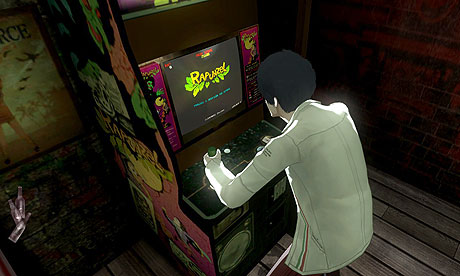


Whew, now that the basic game play is explained we can talk about some of the extras in Catherine.  The good news about the extras could also be considered the bad news.  It’s all more block puzzles.  This could be great if you are looking for more puzzles after playing through the game, but if you are looking for a little variety, there isn’t very much.  The first little extra that is open to you is the arcade game “Rapunzel” which is located in the “Stray Sheep” bar.  When you first approach it in the game, it will inform you that you only get to play it three times per night (ok, dad), so you will probably have to go back on different days if you want to complete all the levels, and there are a lot.  128 of em.  Yup, go crazy.  There are 64 standard stages that you need to complete in order to unlock the 64 extra stages (if you really want to, that is).  The difference in this little arcade game is that the ground is not falling out from below you, but you do have a limited number of push/pulls you can perform.  The other mode you can play around with is called “Babel”.  There are 4 different Babel stages which require you to get gold medals in the story to unlock.  The modes are called Altar, Menhir, Obelisk, and Axis Mundi and you will need 1, 3, 5, and 9 gold medals to unlock each one respectively.  Each mode is randomly generated block towers, but they each get longer and utilize more of the trap blocks.  If, or rather when, you die in one of these modes, your best height and time will be sent to an online leader board.  There is one definite, glaring flaw with Babel mode.  Despite how far you have gotten in previous attempts, the game will announce “new record!” each and every step you take.  So, you better get used to hearing “new record!” nonstop for a long time if you are planning to reach the top.  These modes can also be played co-operatively, although I found having another player to be more of a hindrance since you cannot stand on the same block, and if one of you drops down on top of the other, you will automatically smack them off the block and down to almost certain death.  That and the fact that it is all too easy for one of you to fall behind and become trapped and if one of you dies, you both lose. 


If multiplayer is what you are looking for, the coliseum mode is probably the best option for you.  It is only unlocked after fully completing the game once.  This mode is a competitive mode where you each try to climb the same tower at the same time, like Babel, but rather than trying to work together (as impossible as that can be) you are encouraged to work against your opponent.  You win this mode by either killing your opponent, or reaching the top first.  Just so there is no confusion, all multiplayer modes in Catherine are local only.  Only the leader boards and graphs utilize your online connection.


Alright, just two more quick points I want to hit before my conclusion, so if you have read this far, just bear with me a little longer.  The first one being graphics.  The in game graphics are decent enough that they won’t distract you, and all the bosses come across as monstrous and scary, but won’t impress you in terms of detail.  The character models, while a bit stiff during cut scenes, still have a lot of expression, at least in Vincent’s case.  The other characters barely seem to change their expressions at all.  Where the game really comes alive is when it changes into anime cut scenes.  These scenes, while unfortunately scarce, are visually appealing and feel very fitting for the genre of the game.  Catherine certainly would have benefited if each cut scene was made this way.  For one thing, while Vincent’s in game model is nearly identical to his anime style; other characters such as Catherine don’t translate as well.  Since Catherine is supposed to be very attractive (to say the least), it is a little disappointing to see how oddly shaped her head looks in game compared to her anime counterpart. 


Before I get into the voice acting, I should confess that I have a strange love for voice acting.  I can’t explain it, but there is something very appealing to me about giving voice to another person, and that is exactly what the voice actors in Catherine have done.  First, I have to give props to Vincent’s voice actor Troy Baker.  He does an excellent job voicing Vincent, and giving him life and personality.  There are a few times I thought Catherine sounded a little too over the top, but otherwise the entire cast gave strong performances, which is somewhat expected from such experienced voice actors.  I won’t gush over this topic any longer because I know it might not be as interesting to everyone else as it is to me.  Bottom line though, the voice acting is solid.  


Whether or not you will enjoy Catherine really depends on if you are ready to play something different from most games being released this generation.  It is uniquely difficult, and at times is fairly thought provoking.  I wish there was a game I could compare it to, or say if you liked this game you will like Catherine, but I just can’t think of one.  Hopefully what I have said here already helped you make up your mind, but if you are still on the fence there are free demos available on both Xbox360 and PS3.  Even after I played the demo, I still wasn’t sure about this game, but picked it up not only because I wanted to support developers who were doing something different, but because I couldn’t really get a grip on what the game really was and was curious to find out.  If you find yourself curious as well, this is a perfect game to try before all the huge winter releases eat all your money.  

-J. Lennox

Wednesday, June 18, 2014

Close Reading: Red Dead Redemption


A brief synopsis-
“America, 1911, the wild west is dying.”  John Marston, the main character of the game, is a former outlaw trying to move on with his life with his family.  Before the game begins, however, his wife and son are held hostage by the Bureau of Investigation,  promising to reunite them and grant him amnesty for his past crimes if he brings his former gang members to justice.  John sets off to find the three members of the gang he used to run with, traveling all across southern America and Mexico, meeting and getting involved with a host of characters along the way.  

What are the theme(s)?-
I kept the synopsis more brief than usual for two reasons.  The first is that the basics of the story are that simple, even though a lot more depth and complexity is woven in throughout the game.  My second reason is because one theme I want to talk about requires me to spoil the ending to the game and I didn’t want to do that without giving fair warning to anyone who has not finished the main storyline and would rather do that before reading further.  Consider this your warning, as I will assume anyone reading beyond this point has either finished the game or does not mind the end being given away.  

As the title suggests, redemption is a major component in this game, but in some strange ways  John’s idea of redemption after a life as an outlaw, is to settle down and live a simple life.  He is forced to hunt down his former gang members by outside forces, and in a lot of ways doesn’t want to.  The obvious reasons are that his family is being held captive, but also the relationship John had with his gang.  John’s mother died during his birth, and his father died in a barfight early in his life, leaving John to grow up in an orphanage.  He ran away from this life and joined a gang led by a man named Dutch, the same gang he would later be sent to hunt down.  John describes his relationship with his gang as being like a family to him, with Dutch taking on a fatherly role for him.  Dutch taught him how to read, hunt, shoot, and generally survive in the world.  He claims that all the robberies, kidnappings, and raids he committed with his gang were in an attempt to better the world.  In a Robin Hood type fashion, they stole from the rich and gave to the poor.  It was only after being shot and abandoned by his gang during a robbery gone wrong that John decided to give up that way of life.  He respects Dutch even after that point, and openly states that he owes him a lot for everything he did for him.  John isn’t looking for redemption in the capture of his former gang, but in creating a life for his family that doesn’t require them to do what he had to.  

After John finished his job for the bureau, his family was returned to him, but they were not planning on letting a potentially dangerous outlaw like him go free.  After only just starting to get his farm and family back in order, a group of soldiers raided John’s farm.  Knowing what they wanted, he sent his wife and son away, and fought them off as best he could alone, but was overwhelmed and killed.  The story continues years later, following John’s son, Jack.  Jack takes on the responsibility of redeeming his father in the only way he thinks is acceptable.  Unlike his father, for Jack redemption can only be achieved through revenge.  He tracks down the now retired agent who was responsible for putting his father through so much to get his family back only to turn around and kill him after he did what he wanted, and guns him down.  The game ends on this scene with the words REDEMPTION smashing onto the screen.  


How it can be used in education-
Redemption is a word that can mean many different things, especially when considering how one goes about achieving it.  Asking students to define what they consider redemption compared to revenge could lead to some great discussions or paper topics, as there is a lot of grey area there depending on the situation.  At what point, if any, do the two meet?  Who achieved redemption in the story?  John, who wanted to put his past behind him despite being betrayed, or Jack who kills the man who murdered his father despite doing what he asked?  Then there are the questions of how the discussion changes depending on how the player chooses to go about capturing his former gang members, as it is up to the player to decide whether or not John kills or captures them alive.

Red Dead Redemption would be a great supplemental text for a unit going over morality and issues of killing and revenge.  Redemption itself is hardly talked about much as a topic in itself, but could fit perfectly as a mini-unit within a larger one.  

As with every interpretation of a text, this is just my own.  I would love to hear your interpretations if you’ve had the chance to play this game, or your thoughts on it having just heard the little bit I described.  Is there a way you would utilize this game that I overlooked, or a flaw in my examples?  Do you have any suggestions for what you’d like to see written about next?  I would really like to start a dialog down in the comments, so respond however you like.

Saturday, March 1, 2014

Close Reading- Deus Ex: Human Revolution


A brief synopsis-
Deus Ex: Human Revolution is set in the not too distant future of 2027 where mechanical augmentations for humans have just started to become widely available.  These include replacement limbs as well as neural enhancements that give a wide variety of benefits.  The player controlled character, Adam Jensen, is the head of security at Serif Industries which is a leader in providing mechanical augmentations, as well as developing new biotechnologies.  His girlfriend Megan Reed is one of the top scientists there who is on the verge of revealing new research that could change the way the world views augmentation.  Before that can occur, Sarif Industries is attacked by a mysterious group of augmented people.  They kidnap Megan, as well as four other researchers, although they are originally presumed dead.  Adam was critically wounded while attempting to repel the attack and was only able to survive after an extensive amount of augmentations were made to his body.  After recovering, Adam seeks to find the people who took Megan and the other researchers, rescue them, and uncover the truth about augmentations.

What are the theme(s)?-
A brief synopsis can’t really do justice to the world that was built in Human Revolution.  Adam’s goals are simple enough, but become more complicated because of the world he lives in.  The biggest of these factors would be the social divide that emerged at the onset of human augmentations becoming more common.  Many people opposed augmentations, claiming that such technology could be abused.  While augments are publicly available, not everyone can afford them, and those that can’t are unable to compete in the job market.  Aside from just making people stronger, neural augmentations could make them think faster and generally more intelligent, which puts them ahead of naturally skilled and hard working people.  Out of this unrest, two anti-augmentation groups were formed prior to the game’s opening.  Humanity Front was started when a shale rig worker was fired from his job so that he could be replaced by augmented workers.  He decided to sue, not for being fired, but for the right to amputate himself in order to have the same advantages as his augmented competition.  The supreme court ruled in his favor, declaring it constitutional for an individual to augment themselves.  Out of this hearing, Humanity Front was created to protest all clinics and companies, most notably Serif Industries, that provide augmentations.  Their primary political stance is trying to keep humanity ‘pure’ of augmentation.  Alternatively, Purity First is a more violent group formed by a formerly augmented veteran of the Iraq and Afghanistan war.  He received a free optical augmentation in exchange for reenlisting in the military, a deal available to all wounded veterans, but removed it after claiming it had driven him to do terrible things during the war.  Purity First was formed out of people who shared a common hate for human augmentation, but rather than peaceful protesting like Humanity Front, they resorted to violence, theft, and vandalism.  These groups, as well as many individuals, think that human augmentation would supplant the social order.


Another consideration Human Revolution deals with is how augmentation can be used as a tool for control.  Aside from the primary character, everyone who undergoes augmentation needs to take weekly doses of a drug called Neuropozyne to prevent their bodies from rejecting their enhancements.  This drug, while not made from any rare or expensive chemicals, is only available from one source.  This source is able to set high prices and control how much of the drug is readily available, thereby enforcing a controlling force on everyone who is dependant on that drug.  Because of how the drug is handled, a large black market for it has also developed.  These illegal sources are essential for other’s who take more direct control of augmented people.  One example you can have a direct interaction with during the game is when you discover a man who runs a prostitution ring where he has all the women working for him augmented so that he can essentially enslave them by restricting their access to Neuropozyne as he sees fit.  

How it can be used in education-
Deus Ex: Human Revolution encompasses a lot of issues under the metaphor of science fiction.  It would be no stretch in logic to ask students to examine the social issues present in this fictional version of the real world, and compare them to what is going on in the present.  The themes of class and power in the game are perfect for examining as metaphors or to contrast with similar issues occurring today.  In addition, looking at augmentation itself raises many philosophical and ethical questions.  On one hand, the game shows how it can be abused and create a divide between people of higher class, but students would also have to consider those who would not be able to function normally without augmentations.  Where would they draw the line in the ethical use of augmentation?  Another question I was unable to talk about in depth, but is just as relevant, is the question of what is human?  How much of a person can be replaced with machines before they cease to be human?  These questions could work very well in tandem with another text where AI is discussed, and the issues around whether or not a computer could be considered sentient or alive.  

I would say Deus Ex would work best in a literary classroom during a unit on dystopia, or science fiction in general, or any one where human ethics come into play.  The near future setting, with technologies not too improbable, could be fertile ground for discussions on dystopias and the idea of the singularity.  It could also be useful as a metaphor when talking about civil rights and the issues around the treatment of minorities.  

As with every interpretation of a text, this is just my own.  I would love to hear your interpretations if you’ve had the chance to play this game, or your thoughts on it having just heard the little bit I described.  Is there a way you would utilize this game that I overlooked, or a flaw in my examples?  Do you have any suggestions for what you’d like to see written about next?  I would really like to start a dialog down in the comments, so respond however you like.

Some common core standards that Deus Ex: Human Revolution can be used on its own, or as a companion text, to satisfy at a 9-10th grade levels of reading literature and writing:

CCSS.ELA-Literacy.W.9-10.1a Introduce precise claim(s), distinguish the claim(s) from alternate or opposing claims, and create an organization that establishes clear relationships among claim(s), counterclaims, reasons, and evidence.

CCSS.ELA-Literacy.W.9-10.1b Develop claim(s) and counterclaims fairly, supplying evidence for each while pointing out the strengths and limitations of both in a manner that anticipates the audience’s knowledge level and concerns.

CCSS.ELA-Literacy.W.9-10.1c Use words, phrases, and clauses to link the major sections of the text, create cohesion, and clarify the relationships between claim(s) and reasons, between reasons and evidence, and between claim(s) and counterclaims.

CCSS.ELA-Literacy.W.9-10.2a Introduce a topic; organize complex ideas, concepts, and information to make important connections and distinctions; include formatting (e.g., headings), graphics (e.g., figures, tables), and multimedia when useful to aiding comprehension.

 CCSS.ELA-Literacy.W.9-10.2b Develop the topic with well-chosen, relevant, and sufficient facts, extended definitions, concrete details, quotations, or other information and examples appropriate to the audience’s knowledge of the topic.


Monday, February 17, 2014

Close Reading- Death Note


A brief synopsis-
Deathnote is the story of what happens when a genius level high school student finds a demonic book called a ‘Deathnote’ which has the power to kill anyone whose name is written in it.  The ‘Deathnote’ is not all powerful, however.  The first warning given to Light, the student who finds the book, by the shinigami (god of death) is that whoever writes a name in the notebook will not be able to go to heaven or hell.  This god of death, named Ryuk, will follow whoever claims ownership of the notebook, neither aiding nor hindering them, while waiting for them to die.  He is only visible to a person who owns a ‘Deathnote’ or is currently holding one.  In addition to explaining the danger of using the notebook to Light, Ryuk also shows him the rules and limitations of it, which are integral to the story.  The first 5, which are the most important are:
1. The human whose name is written in this note shall die.
2. This note will not take effect unless the writer has the person’s face in their mind when writing his/her name.  Therefore, people sharing the same name will not be affected.  
3. If the cause of death is written within the next 40 seconds of writing the name, it will happen.
4. If the cause of death is not specified, the person will simply die of a heart attack.
5. After writing the cause of death, details of the death should be written in the next 6 minutes and 40 seconds.  
Working around these rules, Light attempts to use the notebook to punish criminals and create a better world.  It isn't long before the trend of criminals dying of heart attacks is noticed by the local police, and a detective known only as L begins investigating the deaths.  Here the story becomes a battle of minds as Light and L attempt to discover one anothers identity without exposing themselves to the other.  

(L on the left, Light on the right, both speaking)


What are the theme(s)?-
Light, in direct opposition to his name, is a perfect example of an anti-hero.  He is arrogant, and somewhat sociopathic, and yet is unarguably intelligent and capable beyond nearly anyone else around him with the one exception being L.  He chose to use the notebook as a means to deliver justice to those he felt should be punished, as he considered the world to be rotten and in need of a rebirth through the cleansing of evil people.  Once the public decided to give the name ‘Kira’ to the person who was killing criminals, with some even praising his actions, Light quickly develops a god-complex.  He is certain that no one but him could handle the responsibility of using the notebook to improve the world.  If his character and motivations were not enough to show his nature, than his explicit statement: “I am justice!  I am the God of the new world, saving it from evil and ridding it of fear.  Those who betray God are the evil ones.”  That one statement confirms both readings of his character.  Referencing himself as the embodiment of justice and God speak for themselves well enough, and while his intentions may seem like that of a typical hero, his methods and mental state mark him as a clear anti-hero.  It gets to the point in the story where ‘Kira’ is accepted and praised by the majority of the population, only fueling Light’s arrogance and God-like self image.  


Another theme worth examining is the underlying reaction of the population during the series.  At first there is a large police response to catching Light, with some sects of the public agree with his actions, while others just view him as a murderer.  As the series goes on, and his power and intelligence prove to be too great a risk for most, only a small task force is left investigating him while more and more people become outright supporters of Kira.  It gets to the point where people who have been wronged begin to worship Kira as a kind of god for dispatching justice to evil.  


Again, there are a lot more characters and themes that could be looked at here, but I’ll move on with just these two examples.


Where it can be used in Education-
While I already talked about character development a great deal in my Persona 4 Close Reading, Death Note offers other character related topics worth examining.  In any unit where anti-heroes are being examined, Light would no doubt be a perfect example to reference.  All of his thoughts and actions, while supposedly done for the good of the world, come and a large price and through selfish intent.  His god-complex is a great contributor to that theme, as well as a worthwhile example of the corruption of power.  Death Note as a whole could be looked upon as what happens when one bored genius gets hold of the power to kill just by writing a person’s name and thinking of their face.  Going even broader, we can attempt to answer the question of what is just treatment of criminals?  Should there be a death penalty?  These questions are very difficult, and students will have very different ideas on the matter, especially those who have personal experience with these issues.  Without getting directly at that same point, the reaction of the general public in the show could be used as a analysis of security vs justice.  The people know Kira, aka Light, is murdering people, but because they are criminals they support him.  As long as they are safe, they are glad to let Kira continue his murderous rampage.  


Death Note offers a broad stroke of themes and ideas that could be utilized across many types of English classrooms.  We have analysis of character (focusing on hero vs anti-hero, god-complex, morals, corruption of power), population and their reaction, and how this story relates to real issues of justice and punishment in our own world.  In terms of creative writing, it is an amazing example of building rules and showing how characters work around, as well as take advantage, of them to try and outsmart the other.  


As with every interpretation of a text, this is just my own.  I would love to hear your interpretations if you’ve had the chance to watch this show (or read the manga), or your thoughts on it having just heard the little bit I described.  Is there a way you would utilize this game that I overlooked, or a flaw in my examples?  Do you have any suggestions for what you’d like to see written about next?  As always, respond however you like.
-J. Lennox


Some common core standards that Death Note can be used on its own, or as a companion text, to satisfy at a 11-12th grade levels of reading literature and writing:


CCSS.ELA-Literacy.W.11-12.1a Introduce precise, knowledgeable claim(s), establish the significance of the claim(s), distinguish the claim(s) from alternate or opposing claims, and create an organization that logically sequences claim(s), counterclaims, reasons, and evidence.


CCSS.ELA-Literacy.W.11-12.1b Develop claim(s) and counterclaims fairly and thoroughly, supplying the most relevant evidence for each while pointing out the strengths and limitations of both in a manner that anticipates the audience’s knowledge level, concerns, values, and possible biases.


CCSS.ELA-Literacy.W.11-12.2 Write informative/explanatory texts to examine and convey complex ideas, concepts, and information clearly and accurately through the effective selection, organization, and analysis of content.


CCSS.ELA-Literacy.W.11-12.2a Introduce a topic; organize complex ideas, concepts, and information so that each new element builds on that which precedes it to create a unified whole; include formatting (e.g., headings), graphics (e.g., figures, tables), and multimedia when useful to aiding comprehension.


CCSS.ELA-Literacy.W.11-12.2b Develop the topic thoroughly by selecting the most significant and relevant facts, extended definitions, concrete details, quotations, or other information and examples appropriate to the audience’s knowledge of the topic.


CCSS.ELA-Literacy.W.11-12.3 Write narratives to develop real or imagined experiences or events using effective technique, well-chosen details, and well-structured event sequences.


CCSS.ELA-Literacy.W.11-12.3a Engage and orient the reader by setting out a problem, situation, or observation and its significance, establishing one or multiple point(s) of view, and introducing a narrator and/or characters; create a smooth progression of experiences or events.


CCSS.ELA-Literacy.W.11-12.3b Use narrative techniques, such as dialogue, pacing, description, reflection, and multiple plot lines, to develop experiences, events, and/or characters.


CCSS.ELA-Literacy.W.11-12.3c Use a variety of techniques to sequence events so that they build on one another to create a coherent whole and build toward a particular tone and outcome (e.g., a sense of mystery, suspense, growth, or resolution).

Sunday, February 2, 2014

Close Reading- Persona 4

This is a new project I am undertaking where I will approach forms of media that are not generally respected or considered to have value outside of their fan bases or as simple entertainment, such as but not limited to videogames and anime, with an analytic eye towards the educational value they have.  The same level of close reading expected in school assignments will be applied here, although presented in a somewhat more casual and brief format.  Because I am coming at this from an English perspective, as well as to keep these posts as succinct as possible, I will mostly be leaving out aspects that might not apply to the theme being discussed such as game mechanics or art styles.   My aim is to broaden what is seen as valuable resources in the classroom.  Books have, and probably will continue, to dominate in that regard, but as has gone on other mediums have started to become integrated such as graphic novels and films.  I see no reason why a newer medium like videogames as a whole should be completely ignored by the educational system.  I don’t mean to say every game has value in every class, or in some cases any, but no medium does.  This will be my ongoing case to advocate all the positives these rejected mediums can offer.  My first topic for Close Reading with be:


A brief synopsis
Persona 4, which despite it’s title is a stand alone game and does not require you to have played the previous installments, centers on the main character, named whatever the player wishes, who goes to a small town to live with his uncle and younger cousin for a year.  He attends the town’s high school and begins making friends with some students.  Not long after he arrives, a bizarre murder is committed, and the victim happens to be the crush of one of his new friends.  They decide to investigate, discovering a mysterious world accessed by entering TV screens filled with monstrous shadows.  Through exploration of that world, it is uncovered that the killer throws his victims inside the TV as his method of murder.  The only way they can be saved is if the player and his friends enter the TV world and rescuing whoever was thrown inside.  In the process, though, each new character that you save who joins you on your journey must face their “shadow self,” a doppelganger that represents that character’s unique repressed or negative aspects they have of themselves.  As the year goes on the group of students grows as the mystery takes turns and unfolds as they try and discover the killer’s identity, as well as what the world inside the TV really is.


What are the theme(s)?
Persona 4 has many strong themes throughout its lengthy narrative.  This is one game, like others I plan on writing about later, that could be discussed at great length, but in the interest of keeping focus we will just look at one for now.  That’s not to say we won’t revisit this or any other topic to explore other themes in the future.  The one we will be looking at right now, however, is that of internal and external conflict.  This game utilizes this theme more effectively, and with greater effect, than many more widely popular texts I have read.  I believe it manages this, in part, due to the diverse nature of the fully fleshed out characters with relatable fears and doubts.  Within the group of main characters, anyone would be able to identify, or at the very least empathise, with the personal demons they must face.  While they are all high school students, and would therefore be easier for other students to identify with, I think the fear of feeling trapped on a set path in life, jealousy of a friend’s qualities, or not feeling comfortable in your own skin, can be applicable to anyone.  Let’s look at just one character for a slightly more in depth example.  


Kanji Tatsumi, a fan favorite, is the killer’s 4th attempted victim.  He is first shown to the player on a news broadcast as a violent delinquent who single handedly starts fights with a biker gang who keep his mother up at night.  He skips classes more than he attends them, and keeps up a tough, and self dependant demeanor at all times.  Once he is thrown into the TV world, however, his shadow reveals a lot about his character.  Here we get to see that the way Kanji presents himself, as an overly masculine street punk, is really just to hide his true interests in things that are more commonly associated as feminine.  The player learns that Kanji’s mother owns a textile shop, and as a result, Kanji himself got quite talented at sewing.  He was taunted and made fun of by other girls for doing something so “girly”, and over compensated in trying to act more masculine as a result.  Being masculine became very important to Kanji’s image of what a man was supposed to be and did whatever he could to prove he was a real man, even if that meant getting into trouble, which was constantly conflicting with his love of sewing and crafts.  His shadow is also represented as being homosexual, but it is left ambiguous whether or not Kanji himself is actually homosexual, or if that was just how his shadow was embodying what his own view of himself would be if he were to give up his act and accept his interests regardless of how people view them.  When Kanji’s shadow is defeated, he starts trying to give up his delinquent act and becomes more open about sharing his interests as time goes on, but is still defensive about it at times.  


A lot more could be said about Kanji and his internal conflicts.  The topic of his sexuality alone could be a strong topic for a persuasive essay, but I’ll leave it with that one brief example for now.


Where it can be used in Education
Understanding character, and character development, are key in achieving deep levels of comprehension.  In order to understand character, you need to know them inside and out.  Persona 4 gives you not only the surface level of a diverse cast of characters, but also a glimpse into their fears, and secret desires.  In other words, their internal struggles as people.  It would not be a stretch to think that Persona 4 could be used as a complementary text, for lack of a better term, when first introducing this topic.  The shadow versions of the main characters, the internal becoming external, could make the concept easier to grasp for some.  One content area of English that I suspect nearly every topic written about will be applicable to, is creative writing.  Character development and growth is an important aspect in that subject, and giving an exercise where students would have to write the shadow version of their main character could really help to flesh them out. Outside of the creative writing space, Persona 4 could be used for some literary analysis.  With the example of Kanji I used earlier, a strong case could be made that his experience with his sexuality could be contrasted against another fictional character’s.  The same could be said for all of the other characters as well.  


If allowed to be the sole, or primary, piece of text for an assignment, I think it would be a waste of time listing all the areas Persona 4 could satisfy.  It has just as much plot, strong characters and character development, and themes to put it at least on par with any young adult/ mystery novel.  


As with every interpretation of a text, this is just my own.  I would love to hear your interpretations if you’ve had the chance to play this game, or your thoughts on it having just heard the little bit I described.  Is there a way you would utilize this game that I overlooked, or a flaw in my examples?  Do you have any suggestions for what you’d like to see written about next, or a better way to organize how I present my writing?  I would really like to start a dialog down in the comments, so respond however you like.
-J. Lennox


Some common core standards that Persona 4 can be used on its own, or as a companion text, to satisfy at a 9-10th grade levels of reading literature and writing:


CCSS.ELA-Literacy.W.9-10.1 (10.1a-10.1c) Write arguments to support claims in an analysis of substantive topics or texts, using valid reasoning and relevant and sufficient evidence.


CCSS.ELA-Literacy.W.9-10.1 Write arguments to support claims in an analysis of substantive topics or texts, using valid reasoning and relevant and sufficient evidence.


CCSS.ELA-Literacy.RL.9-10.1 Cite strong and thorough textual evidence to support analysis of what the text says explicitly as well as inferences drawn from the text.


CCSS.ELA-Literacy.RL.9-10.2 Determine a theme or central idea of a text and analyze in detail its development over the course of the text, including how it emerges and is shaped and refined by specific details; provide an objective summary of the text.


CCSS.ELA-Literacy.RL.9-10.3 Analyze how complex characters (e.g., those with multiple or conflicting motivations) develop over the course of a text, interact with other characters, and advance the plot or develop the theme.


CCSS.ELA-Literacy.RL.9-10.6 Analyze a particular point of view or cultural experience reflected in a work of literature from outside the United States, drawing on a wide reading of world literature.